

Short answer: Neither 12V nor 24V is automatically the right choice for every child. Start with the individual ride-on's age guidance, rider height and fit, weight limit, seat space, speed settings and controls. Then check the surface and slope where it will be used, the vehicle's motors, drive system and wheels, and every charging and operating instruction supplied for that model. Voltage is one comparison point, not a complete suitability rating.
If you are shopping in Canada, this guide will help you build a safer shortlist before comparing current 12V ride-on cars and 24V ride-on cars.
What do 12V and 24V mean on a kids ride-on car?
12V and 24V describe the nominal voltage of the vehicle's electrical system. A 24V system uses a higher voltage than a 12V system, but that fact alone does not tell you the vehicle's speed, runtime, passenger capacity, terrain ability or suitability for a specific child.
Two ride-ons with the same voltage can still have different motors, speed modes, wheels, drive systems, weight limits and controls. Compare the complete vehicle specification instead of treating voltage as a grade or age rating.
Does voltage decide which age group a ride-on fits?
No. Age can be a useful starting point, but it cannot replace the current product and manufacturer limits or an actual fit check.
For general browsing, KidsVIP often positions standard one-seater ride-ons for children around ages 1 to 3–4 and many 24V one-seaters for children around ages 3 to 6. These ranges are shopping guidance, not a fit guarantee. Always follow the stricter age and weight limit listed for the individual model. Also check the child's height, legroom, ability to use the controls and comfort at the model's available speed settings.

What should you compare besides voltage?
| What to check | Why it matters | Where to verify it |
|---|---|---|
| Age, height and rider fit | A child needs enough room to sit comfortably and use the controls. | Current product information, manufacturer guidance and seat dimensions when available. |
| Weight and passenger limit | The stated limit applies even when the seat looks large enough. | The individual product specification or manual. |
| Speed settings and controls | Models can have different speed modes and adult-control features. | The exact model's feature list and operating instructions. |
| Motors, drive system and wheels | These affect how the vehicle behaves on different surfaces. | The current model specification. |
| Surface and slope | Pavement, grass, loose ground and hills place different demands on a ride-on. | The model's stated operating limits and the conditions where it will be used. |
| Charging and care | Charging time, runtime and care instructions are model-specific. | The supplied charger, product instructions and manufacturer manual. |
Is a 24V ride-on always faster than a 12V ride-on?
No. A model's listed speed range and speed modes are the information that matters. Motor configuration, gearing, vehicle design, rider load and control settings can all affect how a ride-on performs. Do not assume the speed from voltage alone.
Before buying, check the exact model for its listed speed settings and confirm whether features such as a parental remote, emergency stop or soft start are included. Those features are not universal across every 12V or 24V model.
Is 24V always better for grass or hills?
No ride-on should be described as suitable for every terrain. Performance depends on the whole vehicle: its motors, drive system, wheels, ground clearance, design, rider weight, surface condition and slope.
Think about where the child will actually ride. A smooth driveway is different from thick grass, loose gravel or an incline. Compare that use with the specific model's instructions and limits. If the product information does not support a terrain or slope claim, do not assume it can handle that condition.

Can two children ride together?
Only use a ride-on for multiple children when the individual model is designed for that passenger configuration and both riders fit within its stated combined weight limit. A product name or wide-looking seat does not prove that two children will fit safely.
When comparing two-seater ride-on cars, check the actual passenger space, seat dimensions when available, combined rider weight and the manufacturer's instructions.
How should you compare charging and runtime?
Do not choose a ride-on using a category-wide runtime promise. Runtime can vary with the battery, motors, rider load, speed setting, surface, slope, temperature, vehicle condition and how the ride-on is used.
Use the charger supplied for the model and follow its current charging and care instructions. Check the product information or manual for any charging-time or runtime guidance. Never substitute a different battery or charger based only on matching voltage.
A practical 12V-versus-24V checklist
- Start with the child: Check the model's age guidance, rider height, legroom, weight limit and ability to use the controls.
- Confirm passenger fit: For two riders, verify the intended seating arrangement and combined weight limit.
- Compare speed and controls: Read the exact speed range, modes and adult-control features for each model.
- Match the vehicle to the surface: Consider the motors, drive system, wheels, slope and ground conditions.
- Read the charging instructions: Use the supplied charger and follow the current product or manufacturer guidance.
- Plan for supervision: Use the ride-on in an appropriate area with adult supervision and complete the model's recommended pre-use checks.
Where can you compare 12V and 24V ride-on cars near Toronto?
KidsVIP has a physical ride-on car showroom at 180 Trowers Road, Unit 16, Woodbridge, Ontario. Families can compare available display models and ask questions about rider fit, controls and intended use. Displays and stock rotate, so call +1 (844) 543-7847 before travelling to confirm which models are currently available to compare.
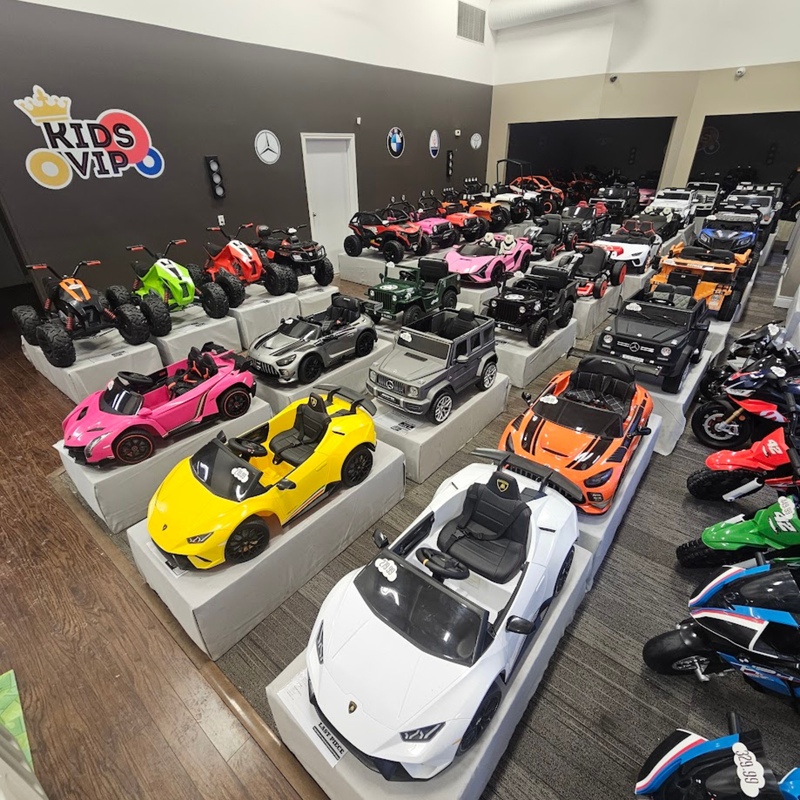
View the KidsVIP Woodbridge showroom information and directions, or contact KidsVIP Canada if you need help narrowing your shortlist.
Already own a ride-on car?
For an existing vehicle, use the KidsVIP ride-on service centre for diagnostic and repair information. For batteries, chargers or other components, browse ride-on car parts and confirm compatibility before purchase or installation.
Final check: The right choice is the individual model that fits the intended rider, use and operating conditions while staying within every listed limit. Compare the complete specification and manual—not voltage alone.
Last reviewed by KidsVIP Canada: October 14, 2026.



Share:
Best electric cars for kids for 2023
How Fast Do 12V Ride-Ons Go?